
International Law & Popcorn
Veranstaltungsreihe im Sommersemester 2026
in Kooperation mit Max-Planck-Institut für ausländisches Recht und Völkerrecht und
der Non-Profit Menschenrechtsorganisation Just Access e.V.
---
Film and Lecture Series during the Summer Semester 2026
in cooperation with Max-Planck-Institute for Comparative Public Law and International Law and
the non-profit Human Right Association Just Access e.V.

Die Filme zeigen wir im Original mit englischen Untertiteln oder in der englischen Originalversion. Die Filmeinführungen und Diskussionen finden auf Englisch statt.
Moderation: Moritz Vinken (Max-Planck-Institut für ausländisches Recht und Völkerrecht)
Filme sind Spiegel gesellschaftlicher Vorstellungen des Rechts, prägen diese aber auch aktiv mit. Sie können Regelungsgegenstände und Funktionsweisen des Rechts greifbar machen aber auch dessen Grenzen, Ohnmacht und Missbrauch aufzeigen. Wir laden Sie mit dieser Filmreihe ein, gemeinsam wichtige Schauplätze und Grundfragen des Völkerrechts durch die Kameralinse zu erkunden und zu diskutieren!
Die nunmehr zweite Saison von „International Law and Popcorn“ widmet sich einigen zentralen Aspekten der aktuell häufig diagnostizierten existentiellen Krise der etablierten internationalen Ordnung. So erscheint das Völkerrecht akut in seinen Grundfesten erschüttert, sein Friedensversprechen ausgehöhlt und seine Machtlosigkeit realpolitisch akzeptiert, ja begrüßt. Das zeigt sich besonders in den Bereichen des Humanitären Völkerrechts und der Menschenrechte, aber auch in dem Wiederaufleben alter Kolonial- und Imperialfantasien. Die drei Dokumentar- und zwei Spielfilme geben zum einen Einblicke in die Auswirkungen dieser Erschütterungen. Zum anderen laden Sie die Zuschauer*innen aber auch dazu ein, diese Entwicklungen als historisch-gewachsene zu begreifen und zu diskutieren.
---
We will show the films in their original language with English Subtitles or in the English Original Version. Introductions and discussions will be held in English.
Moderation: Moritz Vinken (Max-Planck-Institut für ausländisches Recht und Völkerrecht)
Films are not only a reflection and sculptor of social perceptions of law. Above all, they make the objects and workings of international law tangible and thereby expose its shortcomings, its limitations as well as its violations and abuses. In this film series, we invite you to explore important sites of struggle of international law through the cinematic lens.
The second season of “International Law and Popcorn” investigates central aspects of the currently frequently diagnosed existential crisis of the established international legal order. Indeed, international law appears to be shaken to its foundations, its promise of peace undermined, and its powerlessness accepted, even welcomed, in ‘realist’ politics.
This is particularly evident in the areas of international humanitarian law and human rights law, but also in the resurgence of old colonial and imperial fantasies. The three documentaries and two feature films provide serve to illustrate and discuss these developments. At the same time, they invite viewers to understand and discuss these developments as historically grown phenomena.
Veranstaltungstermine | Event Dates:
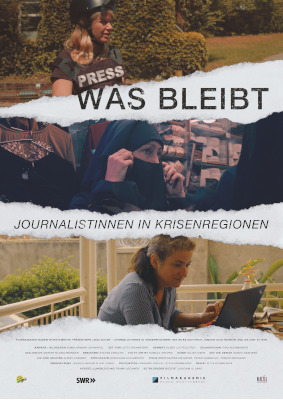
WHAT REMAINS - Journalists in Crisis Areas (OmeU)
D 2023 | Director: Lotta Pommerien | 79 Min.
Documentary
Mo, 02.03., 20:00 Uhr
discussed by the movies's director Lotta Pommerien & Annika Knauer (Max-Planck-Institute for Comparative Public Law and International Law)
Patriarchy in Action: How International Law Fails Women Journalists
Gaza marks the single deadliest conflict for journalists in history. Yet, when women journalists risk their lives to seek information in conflict zones, international law offers them little more than fragmented protection. The Geneva Conventions and some specialized UN Security Council Resolutions remain blind to the gender perspective, while the Convention on the Elimination of Discrimination Against Women fails to account for the vulnerabilities of journalists in conflict zones. The lived experiences of patriarchal structures are perpetuated by the law. The presentation gives a brief overview of the fragmented protection framework for women journalists in international law, and discusses how their experiences in Gaza, Afghanistan, and beyond expose the need for a gender-sensitive approach to legal protections for women journalists in conflict zones.
Pictures of destroyed houses, crying women and children, injured soldiers - we are confronted with such images every day. It seems to be seething all over the world. The terrible news of our time appears on our screens, in the newspapers, on television. But who actually delivers this news? And how are these people dealing with the situation in crisis areas? This film accompanies Silke Diettrich, Juliane Tutein and Simone Schlindwein at their work in crisis areas.India/Afghanistan, Belarus/Ukraine, Uganda/Congo - these are the countries from which these women report. They must deal with patriarchal structures, dictators and terrorist organizations. Does their gender play a role in their reporting? How do they manage to constantly commute between exceptional situations and private life?
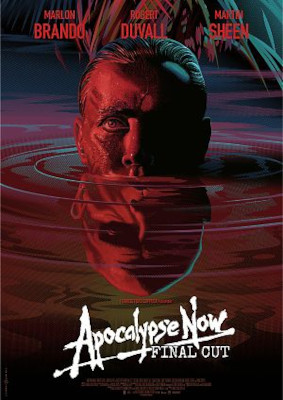
APOCALYPSE NOW (engl. OmU)
USA 1979 | Director: Francis Coppola | 180 Min.
Cast: Marlon Brando, Robert Duvall, Martin Sheen
Mo, 20.04., 19:30 Uhr
discussed by Leon Seidl (Max-Planck-Institute for Comparative Public Law and International Law)
Making the horror palatable
How do murdered civilians turn into “collateral damage”, two-ton warheads into “surgical strikes”, indiscriminate bombing into “counterinsurgency”? The discussion will interrogate the role of public discourse, and particularly the discourse over international humanitarian law, in normalizing war for a domestic audience. From the forests of Vietnam to the streets of Gaza, this issue has lost none of its relevance.
A classic film from 1979, directed by Francis Ford Coppola.
It tells a fictional story set in the 1960s during the Vietnam War. The central character is an army captain sent by boat deep into the Cambodian jungle to capture a special forces colonel who is presumed to have lost his mind. The film is partly based on Joseph Conrad's novel "Heart of Darkness," which recounts a journey down the Congo River.
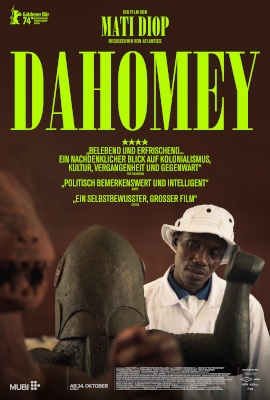
DAHOMEY (OmeU)
BEN,F,SN 2024 | Director: Mati Diop | 69 Min.
Documentary
Mo, 11.05., 20:00 Uhr
discussed by Matthias Goldmann (Max-Planck-Institute for Comparative Public Law and International Law)
The Presence of the Past
Former colonial powers often claim that they were entitled to take objects from their colonies. But is this really true? Even if: Should courts today apply legal rules from the past that are mountainously unjust?
November 2021. 26 royal treasures of the Kingdom of Dahomey are about to leave Paris to return to their country of origin, the present-day Republic of Benin. Along with thousands of others, these artefacts were plundered by French colonial troops in 1892. But what attitude to adopt to these ancestors’ homecoming in a country that had to forge ahead in their absence? The debate rages among students at the University of Abomey-Calavi. (Berlinale 2024)
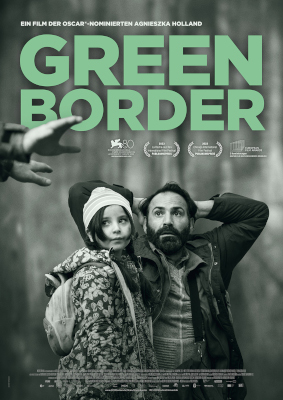
GREEN BORDER (OmeU)
PL,CZ,F,B 2023 | Director: Agnieszka Holland | 152 Min.
Cast: Jalal Altawil, Maja Ostaszewska, Behi Djanati Atai, Mohamad Al Rashi, Dalia Naous, Tomasz Włosok
Mo, 08.06., 20:00 Uhr
discussed by Dana Schmalz (Max-Planck-Institute for Comparative Public Law and International Law)
The violence behind the securitisation of European borders
There has been much talk about the “instrumentalization of migrants” in European law - whether in the reforms of the Common European Asylum System or in cases before the European Court of Human Rights (ECHR). Such instrumentalization of migrants is often described as part of a hybrid attack from a Belarus, a framing that easily omits the individual stories of the migrants involved. The movie “Green border” offers a glimpse into those individual stories. It portrays the violence at the border and the way this affects not only the lives of migrants but also of those involved in perpetrating the violence to “secure” European borders. The discussion will connect the scenes of the movie with current legal developments such as the new Crisis Regulation and the pending cases before the ECHR.
It will outline what European law prescribes regarding the treatment of migrants and what avenues exist to address violations of those laws as they are realistically portrayed in the movie.
The “green border” is a forest area between Belarus and Poland. On the run from war and terror, Bashir’s family and the teacher Leila, respectively from Syria and Afghanistan, believe they can reach the EU through here. Instead, they become the victims of political scheming and propaganda. Their fates are intertwined with those of characters on the Polish side: Julia, who becomes an activist on impulse, and Jan, a young border guard.
A tender and angry film, told with profound humanity. In crystalline black-and-white, reminiscent of many major works of Polish cinema, Holland lays bare the drama of our present. (IFFMH)
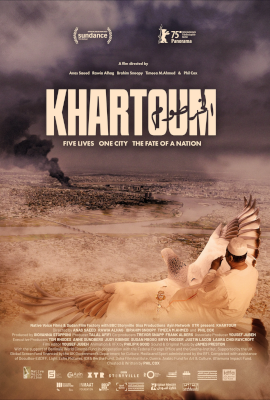
KHARTOUM (OmeU)
Mo, 06.07., 20:00 Uhr
discussed by Mark Somos (Just Access e.V.)
SUD/GB/D/Q | Director: Anas Saeed, Rawia Alhag, Ibrahim Snoopy, Timeea M. Ahmed, Phil Cox | 80 Min.
Documentary
Khartoum (2025) is out of control. Filming began before the latest civil war broke out in April 2023. Most people, in and out of Sudan, thought the conflict wouldn’t last long, so the film-makers stayed and captured both its outbreak and entrenchment. In the final version, which won the Peace Prize at the Berlin Film Festival, pre-war footage is intercut with the reenacted memories of five survivors who managed to flee: two boys, Lokain and Wilson, Majdi, a civil servant, Khadmallah, a tea stall owner, and Jawad, a resistance committee volunteer.
Khartoum is laudably out of control not only because it captures unfolding events, but also because it chooses to gift considerable creative autonomy to the survivors. To tell their stories in their own way, each survivor asks the others to help reenact key experiences. The boys become someone’s sons, Khadmallah stands in for a girlfriend, Majdi and Jawad act as both victims and perpetrators in someone else’s recreated recollection. Their memories flow seamlessly into one pool that becomes a silent, undogmatic and clear mirror for us, viewers.
Thanks to its creativity, authenticity and dignity, Khartoum turns its surrender of control into an asset. In it, a nation, its many tribes, and its 54 million people - 25 million of whom are starving, 22 million are children, 10 million are internally displaced, and 4 million have fled abroad - find a voice and are shown in vibrant colour. Khartoum’s intense humanity will change you; at least for a while.